Sunday, May 11, 2014

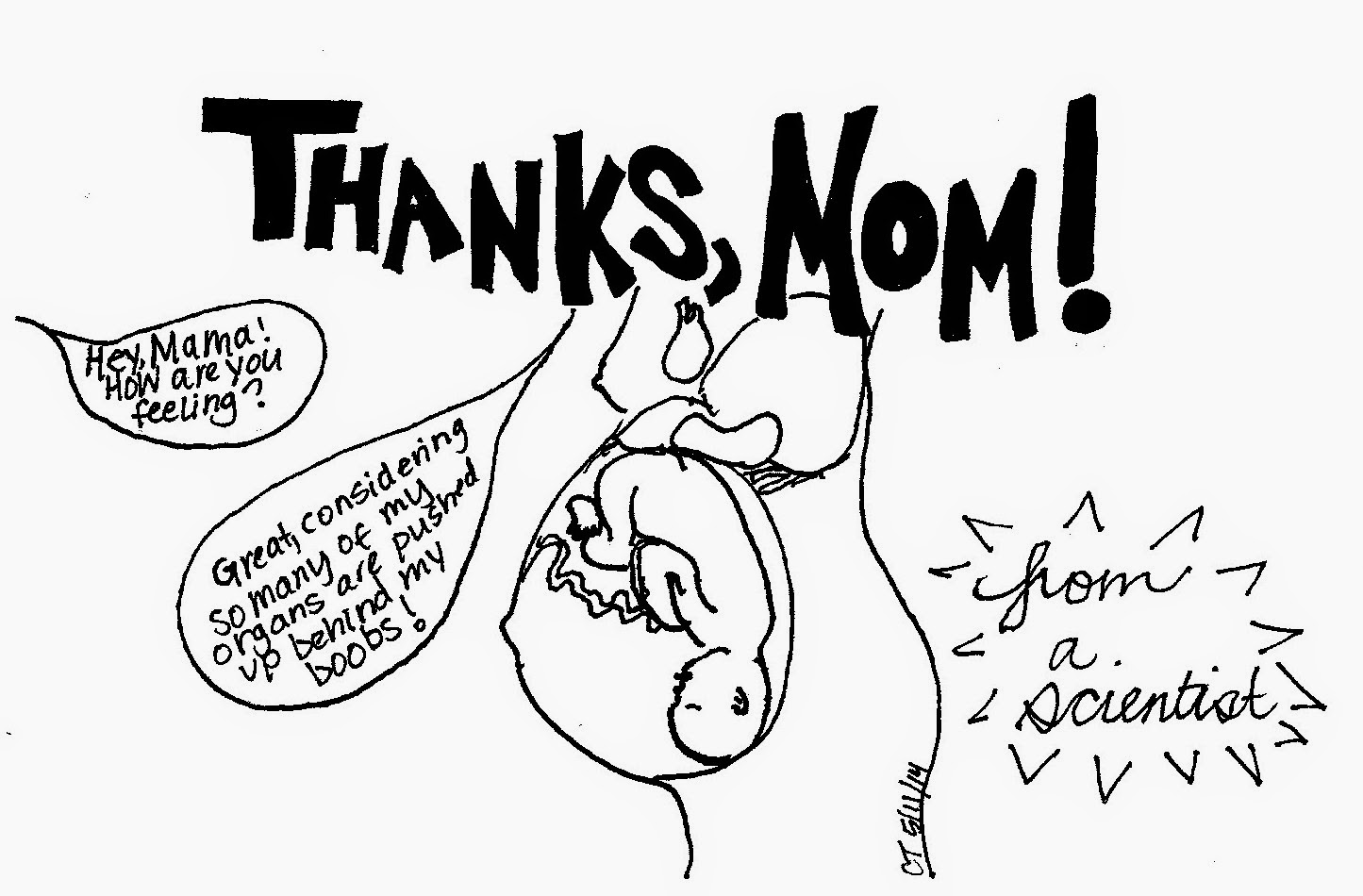
Thanks, Mom! From A Scientist.

Dear Mom,

Like a parasite, I implanted in your uterus and immediately started demanding resources. Your body had to begin adapting quickly, in order to keep up with my rapid cell division. When you discovered what I was up to (and you had to pee on a stick to do this), you felt nothing but excitement and gratitude. Imagine! Even though I was making you feel nauseous, causing you to vomit with little warning, and zapping your energy, you didn't mind.

As I grew, so did my demands. Before I came around, your uterus had a volume of 10 mL. Over the course of my fetal development, it expanded to hold nearly 5 L. That's a 500x increase!! In order to make space for me, your organs had to shift dramatically. That's right, you moved your organs for me!  Your abdominal organs, diaphragm, rib cage -- and even your heart--- were pushed upwards by your bulging uterus. Did you complain? Maybe a little. Mostly you felt overjoyed by my growth and comforted by my bladder-crushing weight and rib-busting kicks and punches.

Your heart rate had to increase to supply me with enough blood. In fact, the amount of blood pumped by your heart during a single minute increased by 30%-50%. Your kidneys lengthened by about 1 cm to accommodate extra fluid. You required about 20% more oxygen, yet all that organ shifting left you with  a 5% decrease in lung capacity. This means you likely suffered from shortness of breath. Much of your glucose intake was used as energy for me or my placenta, requiring you to increase your caloric intake. However, due to hormonal changes, your digestion wasn't quite as efficient. It took 15%-30% longer for contents to move through your intestines (read: constipation). Not to mention, you probably had some nasty heartburn. This sounds like a recipe for feeling rather blah and a great excuse to lay around binge-watching TV. But, no, you didn't let all this discomfort slow you down. Instead, you bustled about preparing for my arrival.

Then came my birthday, triggered by excruciating uterine contractions that probably constitute the greatest pain you've ever endured. You were in labor for hours, but unlike running a marathon, no snacks were allowed! Those nurses would only give you clear fluids and ice chips due to the risk of aspiration and the inability of your digestive system to function well during labor. You were willing to let a surgeon cut through all your abdominal muscles and into your uterus to pull me out, if need be. You risked having an episiotomy (an incision to enlarge the vaginal opening). You endured all this pain so your cervix could transform from a length of 2 cm with an opening of less than half an inch, to a circular opening with a diameter of 10 cm (nearly 4 inches). Through a feat that can be described as nothing short of pushing the human body to its ultimate limits, you delivered me into this world to take my first breath. And if that weren't enough, you also had to deliver my placenta!

The anatomical and physiological sacrifices you made for my fetal development and birth make you a bad-ass superhero. But they only represent a tiny fraction of the love and sacrifice you've shown every day since.

Thanks, Mom. And Happy Mother's Day!

Love,
Your first-born F1 XX

Reference:
Beckmann, CRB, Ling, FW, Herbert, W,  Laube, DW, ,Smith, RP, Casanova, R, Chuang, A, Goepfert, AR, Hueppchen, NA, Weiss, PM. 2013. Obstetrics and gynecology. 7th ed. Philadelphia: Lippincott Williams & Wilkins.

claimtoken-536fd4f72beb6

Wednesday, January 1, 2014

Break a Sweat, Not Your Bones


Happy 2014! With the arrival of the new year, your local gym is about to get a lot more crowded. If you are resolving to begin or maintain a fitness regimen, here's some motivation to break a sweat ...

While there are plenty of benefits to routine exercise, it's easy to forget that exercise is more than skin - and muscle - deep. Hey, I'll be the first to admit that my greatest motivations for heading to the gym are: 1) visions of Michelle Obama's arms and 2) grand ambitions for a firm bodonkadonk.

An often overlooked benefit of exercise is the tremendous impact it can have on your skeleton. You may feel like you have old bones, but in reality your bone cells are constantly removing old tissue and creating new bone through a process called remodeling (yes, much like home remodeling but without the steep prices) . In fact, bone remodeling occurs at such a rate that the majority of the adult skeleton is replaced every 10 years! Are you feeling younger yet?

It's easy to see how exercise affects your muscles - the more you use them the stronger they get. It may not be as obvious, but your bones respond in a similar way. Engaging in weight-bearing exercise tells your bone cells, "these bones are in high demand, let's build them up and make them stronger so they can withstand all this activity".

Though you can't flex your strong bones to show them off, just remember this: your strong bones can prevent you from developing a hunchback. Now that's a reason to keep your gym membership.

Saturday, July 20, 2013

Chadwick's Sign (or why your cervix might be blue)

Sore boobs, nausea, mood swings, fatigue - no, these are not lyrics to a clever rap song (that I'm aware of), rather these are classic symptoms of early pregnancy. If you have these symptoms, possess functional female reproductive organs, and have had vaginal intercourse with a sperm-bearing partner in the recent past, you could always pee on a stick to find out if there is an embryo inhabiting your uterus. But, wait, there's another early pregnancy indicator that you might not be aware of: Chadwick's sign!

Under usual circumstances, the cervix is pink (cervical pink, now there's a new crayon color just waiting to be invented). With pregnancy, blood flow to the uterus dramatically increases, resulting in the cervix developing a bluish tint. This color change is referred to as Chadwick's sign, which can appear as soon as 6 weeks after conception . Ok, ok, so maybe this is not the most convenient way to gauge whether you might be pregnant, unless you are hypermobile, or have an exceptionally curious partner, but still, it's quite fascinating. Plus, cervical self-exams are completely possible (more info available at: http://www.beautifulcervix.com/participate/).

A woman's total blood volume actually increases 30-50% during pregnancy, so it's no wonder that this can make your cervix a little blue.

Saturday, March 23, 2013

Normal Blood Pressure: It's Vital


You can't get through a trip to the doctor without having a blood pressure cuff wrapped around your arm. It doesn't matter if you were at the same office three days ago or if you are coming in for an obvious case of poison ivy - your arm will not be escaping the cuff. Someone will slap that sucker around your biceps, pump it up to give you a nice squeeze, mysteriously listen to your elbow through their stethoscope (it's weird when you think about it), and then mutter some numbers that may or may not be good. If you're lucky, you'll hear something to the effect of: "118 over 72".

Everyone knows that a normal blood pressure is essential to being healthy, but what exactly is blood pressure? What do those numbers actually tell us? Why is blood pressure important enough to be a VITAL sign? Why does everyone freak out when the numbers start to creep up, even slightly? And why, oh why, is high blood pressure associated with so many terrible things (heart attack, stroke, kidney failure, death... you know, those kinds of terrible things). 

To appreciate the importance of blood pressure, we must first understand: 1) pressure and 2) what happens in your body during a single heart beat. Don't be intimidated and stop reading. This isn't going to include crazy diagrams or calculations (it could but that's already been done). 
  • Pressure: this is a word we all use and understand, but let's dissect (pun gleefully intended) the meaning as it relates to blood pressure. Pressure, in the world of physics, is a calculation based on the amount of force that is being exerted on a given area. Your blood pressure is the amount of force applied to the walls of your arteries as blood flows through them. Why two numbers? Let's talk about your heartbeat first...
  • When your heart beats, it contracts, pumping blood out of your heart to circulate throughout your body. During the fraction of a second between heartbeats, your heart is relaxed and refilling with blood.The contraction phase of the heartbeat is referred to as systole and the relaxation phase is termed diastole. Hence, your systolic blood pressure (top number) is the pressure exerted on your artery walls when your heart is contracting. Your diastolic pressure (bottom number) measures the pressure while your heart is relaxed.
Now that you understand what blood pressure is measuring, it probably makes intuitive sense why high blood pressure (also called hypertension) can be so damaging to your body. First of all, if your blood pressure is too high, it is causing your heart to work harder than normal. Second, the increased pressure can damage your blood vessels and to organs such as your kidneys. Damage caused to your blood vessels can include tears, which are prime areas for build up of plaque, thus causing narrowing of the vessels, in turn leading to stroke or heart attack. High blood pressure can even lead to rupture of blood vessels, as occurs in an aneurysm (basically the pressure can cause an artery to explode... BAD NEWS). 

Unlike low blood pressure, which is symptomatic (dizziness, fainting, etc), high blood pressure is usually asymptomatic until it causes one of the aforementioned terrible things to happen. This is why it is incredibly important for high blood pressure to be treated as soon as possible. Click here for more information on prevention and treatment of high blood pressure. 

So, next time you get your blood pressure measured, don't think "oh not this again" but be grateful for the opportunity to catch high blood pressure before it gets out of control. It's vital!

Thursday, January 17, 2013

Dental Floss: Your Daily Biofilm Demolition

We've all heard that flossing should be part of our daily oral hygiene routine, but why?? Less than half of us (in the U.S.) actually follow this recommendation. I suspect* it has something to do with the following:

1) Flossing is fundamentally strange and appears to be more an act of masochism than one of self-care. If a dentist were to describe flossing to someone unfamiliar with the practice it would go something like this: "Now, I want you to take this string and force it between your teeth. Then slide it all the way up into the space between your gum and tooth. Don't worry if you have a mouth full of blood, that will go away after you get used to it. Repeat that for every tooth in your mouth" Ummm, that's supposed to be good for me?

2)  Flossing, from the perspective of the human eye, offers little instant gratification. On occasion, a visible food particle might get removed but mostly there isn't much to see. Should you skip a day, or even a week of flossing, you likely won't notice any difference. Fail to brush your teeth and you'll have retched breath. Skip bathing and soon you'll be oily and stinky. But hey, nobody has to know that you were tired and skipped flossing last night, right? And then you skipped the night after, and the night after...

As you can probably guess, this post is not about why you should never floss. Here's the deal: flossing is actually incredibly important but its daily impact occurs on the microscopic level. With an understanding of this impact, you may learn to appreciate the power of dental floss.

We all have mouths full of bacteria - some are helpful and others can lead to the development of cavities, gum disease, and other oral health maladies. Our teeth are prime real estate for the formation of biofilms, which are communities of bacteria that adhere to surfaces and surround themselves with tough, protective matrices. Just like other organisms, bacteria find safety in numbers and are able to accomplish greater feats as a team than on their own. On a daily basis, biofilms begin to form on your teeth within minutes after brushing. Go ahead, feel your teeth right now - notice that slimy quality they have? That, my friend, is a biofilm referred to as dental plaque. The longer these bacterial communities are left undisturbed, the tougher they become. When we brush, the biofilm foundations are damaged and the bacteria are prevented from advancing too far in their building efforts (do you really want bacteria building sky scrapers and condos on your teeth?). There are crevices in your mouth that a toothbrush can't reach, such as between your gum line. Though you can't see this with your naked eye, flossing is like a dynamite explosion to the plaque taking up residence between your teeth and gums. Without this daily demolition, plaque continues to build up and eventually hardens into dental tartar (also called calculus, but not the kind you learn in math class), which can only be removed by the scraping of  professional dental instruments (a far more terrible and awkward experience than flossing). If not removed, dental plaque and tartar can contribute to a wide array of periodontal disease, not to mention an unsightly and malodorous smile.

There you have it, the truth behind why you really should slide that string between your teeth every day.

*This suspicion is based purely on my personal reflections and observations and is not (to my knowledge) backed by a reputable source of scientific data. If someone would like to turn this into a testable hypothesis, please be my guest.

Thursday, December 6, 2012

Your belly is a bacterial bonanza (and that's a good thing)

Get this: it turns out your body is analogous to a planet. A planet inhabited by trillions of microbes (bacteria, archaea, viruses, and fungi)* which add up to comprise 1-3% of your total body mass. That means if you weigh 150 pounds, you are carrying 1.5 - 4.5 pounds of bacteria (and other microorganisms) around with you everywhere you go (as a point of comparison, the average adult human brain weighs 3 pounds). In terms of mass, your cells outweigh those of your microbial inhabitants. But, don't be fooled: microbial cells are much tinier than human cells. You actually have 10 times MORE microbial cells in and on your body than you do human cells. In other words, you are 90% microbial cells. BOOM - that was the sound of my mind (and probably yours) being blown.

Now before you try to swallow a bottle of antibiotics or scrub your skin raw, you should know that you need most of these microbes to survive. Nasty bacteria that cause infection and illness have been giving friendly bacteria a bad reputation - until now! Science is just beginning to unravel the complex relationships between our bodies and the microbes that normally inhabit us. While there are commonalities in the types of bacteria that tend to colonize specific regions of the body, every person's microbial population is unique in its demographics (much like no two cities have identical census data). The types of microbes that call your body home, and the ratio of different species, can affect your health in different ways.

One of the areas of our bodies that is rife with bacteria is, no surprise, our gut.  Studies about gut microbes are beginning to pile up evidence to indicate that these bacteria are no small players. You need bacteria in your digestive tract to produce enzymes for digestion, to aid in vitamin synthesis, and to produce products for your immune system. Your metabolism depends on them! Additionally, the variety and amount of bacteria in your gut can have far-reaching implications. Your gut microbes could play a role in how much you weigh. They might positively or negatively influence your risk for cardiovascular disease. They could affect how efficient your body is at breaking down certain nutrients. Gut microbes may even shift in composition to accommodate alterations in metabolic demands, such as in pregnancy.

Not only are these new findings exciting for the future of science and medicine, they are also paradigm-shifting in how we view metabolism. As we all know, our society tends to place quite a bit of blame on individuals who struggle with obesity: but what if some obese people just have overly efficient gut microbes? Chew on that.

As if all this news isn't wonderfully mind-boggling and curiosity-piquing enough, YOU can actually contribute to the future understanding of how gut microbes affect our well-being: http://www.indiegogo.com/americangut

If that's not cool, I don't know what is.

*This post focuses on bacteria, since they are currently the main type of microbe under investigation in studies related to the human microbiome. I suspect that in time we will advance our scientific knowledge to equally understand the role of each of these microbes. It's going to be super-exciting, health and life-changing stuff. You can quote me on that.

Wednesday, November 14, 2012

Let Your Meat Take the Heat!


If you live in the U.S., chances are that you looked at the calendar this week and were surprised to realize that Thanksgiving is next Thursday. That's right folks, time to plan your menus because the government is giving us the day off to stuff our faces. Don't despair, I'm not about to tell you that your soon-to-be heaping plate of thanks is unhealthy. I'm a firm believer of everything in moderation (Alright, not everything. Heroin in moderation generally doesn't work out). In other words, just don't eat like it's Thanksgiving every day and you'll be fine.

What you should know, if you're an omnivore who plans to partake in gobbling up some turkey meat, is safe tips for preparing your holiday fowl. If all that meat is not thawed, cooked, and stored properly, the only thing you'll be thankful for is your toilet. You see, if you aren't careful, there are plenty of opportunities for your turkey to become overgrown with types of bacteria that cause food borne illness. To keep your Thanksgiving food-poisoning-free, here are some guidelines for safe turkey cooking:

  • There are three thawing methods that have been deemed safe for turkeys: in the refrigerator, in cold water, or in the microwave. Detailed instructions on each method can be found here
  • Not all cooking methods are equal. Deep fried turducken anyone??? A variety of safe cooking methods can be found here.
  • If you choose to stuff your turkey (yes, it's as dirty as it sounds), be sure to do so immediately before cooking. The stuffing should also reach a minimum temperature of 165 degrees Fahrenheit.
  • Leftovers, because that's bound to happen, should not be kept out at room temperature for longer than two hours. Before you take a nap, put the turkey in the refrigerator! Leftover turkey can be safely stored in the refrigerator for up to four days or in the freezer until it turns into a freezer burned icicle (about 6 months). 

Happy turkey day to all and remember to let your meat take the heat!