Showing posts with label microbiology. Show all posts

Monday, October 1, 2012

Lady Mosquitoes: Free Rides for Pathogens


Itchy welts left behind by mosquitoes are one thing, but the microscopic friends they can leave behind are another thing all together

Mosquito-borne diseases have been making national headlines recently through record-breaking numbers of West Nile virus and emerging cases of Eastern equine encephalitis. Though these are certainly newsworthy trends, there is nothing new about how good mosquitoes are at transmitting infectious diseases. It should come as no surprise given all the extra time they've had to evolve.While mosquitoes have been flying around Earth for approximately 220 million years , modern humans emerged only 200,000 years ago. This means that to mosquitoes, we really are nothing but fresh meat. At least to lady mosquitoes.

Female mosquitoes are the only ones interested in feeding on us as they need protein from our blood to develop their eggs. They track us down by scent, visual clues, and heat detection - all so they can use us as a blood meal for the purpose of laying up to 300 eggs. Unlike vampires, mosquitoes don't actually bite. Why are they called mosquito bites? Good question. Instead of biting, they actually pierce our skin with a mouth part called a proboscis. This is basically a needle-like structure that is used to suck our blood.

Since lady mosquitoes are essentially sticking us with used needles* every time they feed on us, it's no wonder they have an affinity for being disease vectors. With all the blood they drink, mosquitoes often slurp up blood-borne pathogens (viruses, bacteria, and parasites that cause illness). These pathogens then get a free ride to a new host without causing any harm to the mosquito, thanks to her anciently refined immune system. Transmission occurs through the mosquito's saliva, which is injected prior to feeding (it contains anticoagulants which are substances that prevent your blood from clotting). In addition to the aforementioned West Nile virus and Eastern equine encephalitis, mosquitoes can also infect humans with several other diseases including:
The upshot? Not all pathogens survive after they've been ingested by a mosquito and therefore cannot be transmitted to a new host. Thankfully, this is the case for HIV. In case you didn't catch that the first time: mosquitoes do not transmit HIV!

Mosquitoes may have millions of years of evolution in their favor, but our big brains have found some ways to make ourselves seem less tasty to wannabe mama mosquitoes. Here are some ways you can prevent yourself from being used as a blood meal when participating in outdoor activities during mosquito season:
  • Use an insect repellent containing DEET, picaridin, oil of lemon eucalyptus (also called PMD), or IR3535.
  • Minimize skin exposure and wear light-colored clothing when in mosquito infested areas (e.g. wooded areas or areas with large bodies of standing water).
  • Minimize areas of standing water around your home.
  • Don't keep windows and doors open unless you have intact screens. 
Another safety measure you can take is to follow recommendations for prophylactic medications and vaccines when traveling to countries with high rates of mosquito-borne diseases.

When I was a teenager I thought smelling like bug spray was worse than putting up with itchy mosquito bites. I would like to officially retract that opinion.


*While the proboscis of a mosquito resembles a needle, a feeding mosquito does not employee the same mechanisms of a hypodermic syringe. Used syringes (also called needles) pose a different set of threats and should not be confused with insects.

Monday, September 17, 2012

OMG Everyone Has Genital HPV


Ok, so not everyone has genital HPV but unless you've taken a vow of life-long celibacy (which you intend to take seriously) chances are you've already had a genital HPV infection, you have one now, or you'll get one in the future. Before you freak out and run to your nearest STD clinic for treatment, take a deep breath and read this post in its entirety.

HPV stands for human papillomavirus, an extremely common virus that infects skin cells, including cells that line body cavities such as the vagina, anus, and mouth. Of the 100+ types of HPV that have been identified, about 40 are able to infect the genital region. While HPV is the most common sexually transmitted infection, affecting at least 50% of sexually active individuals, it has many characteristics that make it complicated, confusing, and unlike other STIs.

To begin with, the outcomes of genital HPV infection are highly variable. Most people with HPV are asymptomatic, will never know they are infected, and will eventually rid themselves of the virus through the defenses of their own immune system. Those are the lucky folks. Some types of HPV result in the development of genital warts while other types cause cellular changes that over time can lead to the development of cancer. In fact, HPV is responsible for nearly all cases of cervical cancer. Speaking of cervical cancer, if you haven't read The Immortal Life of Henrietta Lacks, please stop reading this and proceed to your nearest bookstore immediately. It's that good.

How people become infected with HPV is rather clear: skin-to-skin contact including contact with mucous membranes. That means anyone who is rubbing their naked body on anyone else's naked body is at risk for genital HPV infection. It doesn't matter what your sexual orientation is or what type of specific sex acts you partake in (sorry kids, dry humping won't keep you HPV-free). Barrier devices such as condoms and dental dams can decrease the risk of HPV transmission but the virus can still be spread to or from areas that the device doesn't cover.

What remains rather murky regarding HPV transmission is when exactly people are contagious and how long people can be infected before displaying evidence of the virus. Also, it is completely possible to be infected with more than one type of HPV. These factors make it nearly impossible to tell how long a person has been infected, who they were infected by, and whether they are at risk for infecting their current or future partners.

Even if you are one of the aforementioned lucky folks, it does not mean that the person you share your HPV with will be so lucky. Different strokes for different folks in the world of HPV. Fortunately, prevention against four of the particularly nasty HPV types is now available in the form of a vaccine. The HPV vaccine Gardasil provides protection against HPV types 6, 11, 16, and 18 and is approved for use in females and males ages 9-26. HPV types 6 and 11 cause approximately 90% of genital wart cases, while HPV 16 and 18 are responsible for most cases of HPV-related cancers. Vaccinating against HPV provides a dramatic reduction in risk, for both yourself and your lover(s). And yes, preteens should be vaccinated before they are sexually active in order to save them the agony of genital warts or an HPV-related cancer. Will vaccinating against a STI cause children to run out and have sex (yes, this is actually a debate to some people)? You tell me - does vaccinating against chickenpox cause kids to run around looking for playmates covered in chickenpox since they are now protected from their oozing pox blisters?

For those of us who have aged beyond 26 or who may have acquired one or more types of HPV prior to vaccination, don't despair! There have been many advances in science and medicine that have allowed HPV-related cancers to become increasingly preventable. Just because you have one of the high-risk (cancer-causing) strains of HPV does not mean you have, or will get, cancer. If you follow your doctor's recommendations for routine health screenings, such as for Pap smears*, the early cellular changes that MIGHT eventually result in cancer, can be monitored and treated before any cancer develops.

HPV may be the most common sexually transmitted infection but there is plenty you can do to decrease its potential harm. Don't let HPV catch you with your pants down!


*While cervical Pap smears are routine for anyone with a cervix, anal Pap smears are not nearly as common. Anyone who frequently has anal sex, particularly MSM (men who have sex with men) who engage in anal receptive sex, should find a medical provider who is educated in LGBT health, or at least willing to become educated, and inquire about anal Paps for detection of HPV-related cellular changes. Paps are not fun but anal cancer is far worse.

Tuesday, September 11, 2012

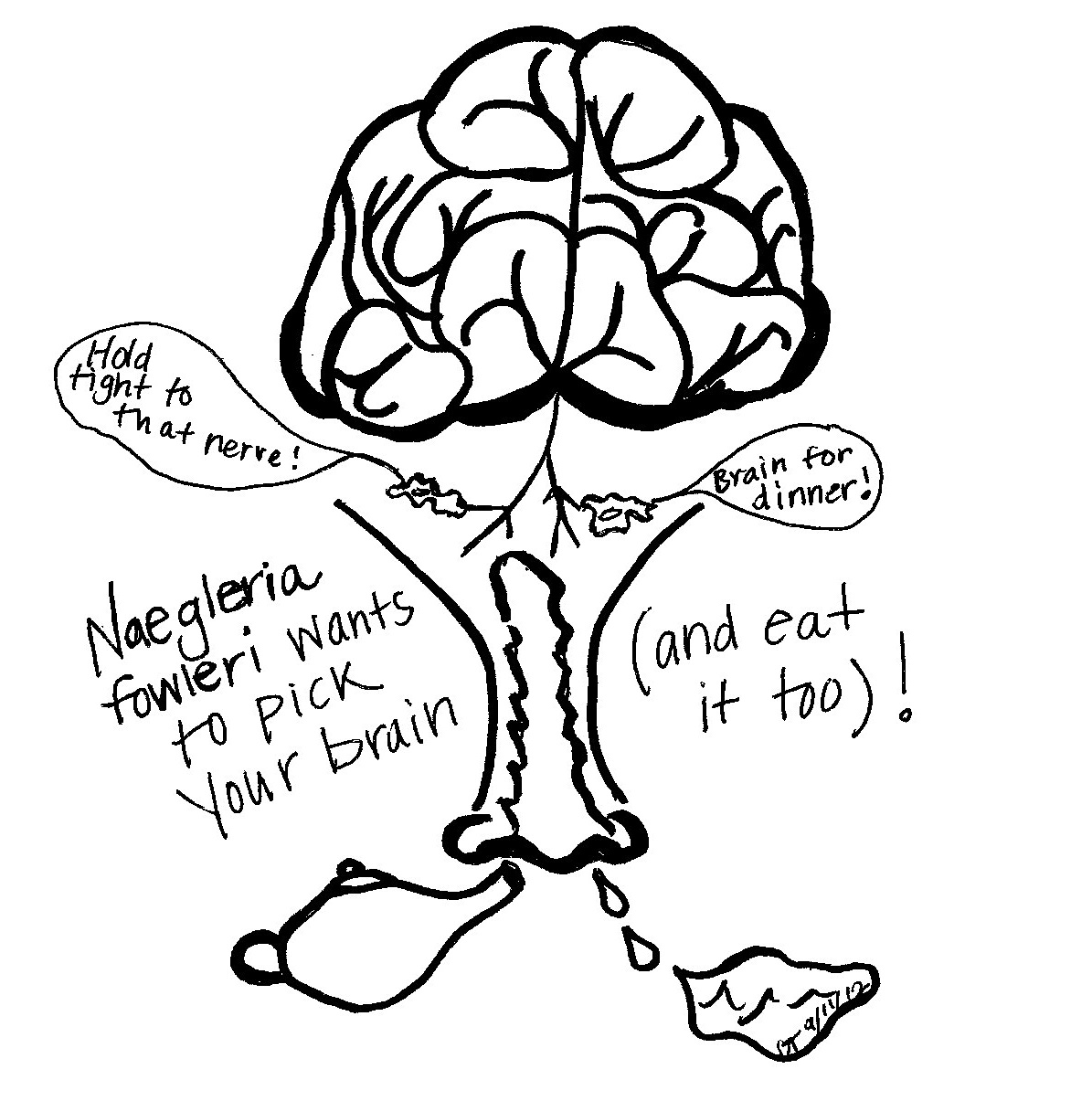
Naegleria fowleri wants to pick your brain (and eat it too)!


Ahhhh, the sweet relief of unclogged, gunk-free nasal passages! While neti pots and other nasal irrigation devices are weird, gross, and just plain awkward, there's nothing quite like being able to breathe freely out of both nostrils. And who wouldn't pour water through their nose if it meant curing the throbbing ache of sinus pressure?

Here's the catch: your sinuses are close neighbors to your brain. If a parasite hitches a free river ride through your nasal passages, into your sinuses, and up to your brain, a stuffy nose will be the least of your worries. Yes, frighteningly enough, this can actually happen. While rare, there have been reports of at least two individuals who have died from parasitic infections following nasal irrigation using tap water. In these cases, the water contained an ameba known in the microbe world as Naegleria fowleri and commonly referred to as the "brain-eating ameba". These parasites can travel to your frontal lobe via your olfactory nerve (the nerve that carries messages about smell from your nose to your brain). As its common name suggests, once N. fowleri reaches your brain it will begin feeding on it. This results in an infection termed primary amebic meningoencephalitis (PAM), a rapidly progressing infection that leads to seizures, hallucinations, and coma. PAM has a fatality rate of about 97%, and victims usually die within 1-2 weeks of symptom onset.

Because of the documented cases of PAM from neti pot use and the risk of infection by other microorganisms, the FDA has recently issued new guidelines for safely rinsing your sinuses. While salt solutions are supposed to be used for nasal irrigation, it would take approximately 18 hours for the salt to kill brain-eating amebas. The only real prevention is to use one of the following water sources when preparing nasal irrigation solutions:

1) bottled water that is labeled as "distilled" or "sterile"
2) water that has previously been boiled  for 3-5 minutes and cooled to lukewarm (if not used immediately, store in a clean and closed container for no greater than 24 hours)
3) tap water filtered through a pore size of 1 micron or less

If you tend to think like me, you'll be wondering: "if this ameba can be found in our tap water, how is it not killing off more people?" The answer is that if we gulp down one of these amebas in a glass of water, it will die once it reaches the vat of acid in our stomachs, leaving us unharmed. But be warned: these microorganisms are usually found in bodies of warm, freshwater and infection most commonly occurs during recreational water activities such as swimming and diving. Do what you will with that fun fact, but I'll be keeping my head above water.

Thursday, August 23, 2012

Toxoplasma gondii: Danger for Baby Mamas

As you may know, pregnant women are advised against cleaning cat boxes for the duration of their pregnancy. You may wonder if OB/GYNs banded together and declared that since pregnant women are busy growing human life in their wombs and all, they might as well be given a free pass from cat box duty for 9 months. Or perhaps it is because if a pregnant woman stoops down to clean the cat box she'll get stuck? These seem like legitimate enough reasons to me, but if you need more incentive to keep pregnant ladies away from cat boxes, try this one on for size: PARASITES! Yep. There is a parasite (a protozoan parasite to be scientifically accurate) named Toxoplasma gondii that can be transmitted in cat poo. Most people who become infected don't get sick because their kick-ass immune system takes charge before the little buggers cause any harm. At the most, they might get flu-like symptoms and never suspect that a cat poo parasite is the culprit. However, if a pregnant women becomes infected for the first time (i.e. she has no previous immunity) she can pass the infection onto her unborn baby. This can result in miscarriage, giving birth to a stillborn baby, or giving birth to a baby who goes on to develop vision loss, mental disability, or seizures. Is that reason enough??

Side note: Recent press has scared cat ladies everywhere by claiming that Toxoplasma gondii causes brain cancer. These rumors have been put to rest. Cat ladies should only worry about their cat negatively affecting their health if they happen to be pregnant cat ladies. Even then, there is no need to avoid your feline friends, just avoid their poo box.